Research

How we chose the material.

Our coffee pods have to survive water at around 200 degrees Fahrenheit under pressure, keep coffee fresh on a shelf for months, and then dissolve or biodegrade. Very few materials do all three. We tested nine and published the results.

The paper

The published paper

Comparative Analysis of Biopolymer Candidates for Sustainable Coffee Pod Manufacturing

Karan Verma and Aditya Herekar

The study combined laboratory testing of biopolymer film samples we made ourselves with a review of the published literature on each candidate. Nine materials were scored against six criteria. Pullulan, polyvinyl alcohol and sodium alginate all dissolved and broke down well. Polylactic acid and cellulose were strongest under pressure. Only pullulan scored well on every criterion at once, which is why it became the pod.

  • JournalFuture Scholars Journal
  • Published23 June 2026
  • DOI10.61340/fsj.2026.08
  • PatentProvisional application no. 64/119,414 · utility patent pending
Prior art

The precedent: bioabsorbable implants

The material brief for Naturista was written by surgery, not by packaging. Bioabsorbable implants are devices designed to be absorbed by the body over time: they provide temporary scaffolding while tissue heals, break down into byproducts the body metabolises, and remove the need for a second operation to retrieve them. Read as a specification rather than as medicine, that is exactly what a coffee pod should do.

What medicine already solved

Modern bioabsorbable devices work by controlled degradation. Polymers such as polylactic acid, polyglycolic acid and poly-4-hydroxybutyrate break down into natural byproducts the body eliminates; magnesium and zinc alloys corrode in a controlled way and are absorbed or excreted. Absorption is tuned by material and application, anywhere from several months to about two years, so support is present through the critical healing window and load transfers back to tissue as the implant disappears.

The clinical advantages are the same ones we wanted: no removal step, no permanent foreign object, and a force profile that becomes more natural as the material degrades. The known limitations are also familiar — bioabsorbable materials are generally weaker than permanent ones and cost more — which is precisely the trade we spent two hundred prototypes negotiating.

Note the overlap in the chemistry: polylactic acid appears both in the implant literature and as candidate four in our screening matrix. It is strong, and it only fully breaks down under industrial conditions. In a body that is acceptable, because the body is the processing environment. In a kitchen bin it is not, which is why the medical shortlist had to be re-scored against soil and a home compost heap instead of tissue.

Implant absorption window
Months to ~2 years
Naturista shell, brewing
20 to 30 seconds intact
Naturista shell, disposal
Days in soil or home compost
Medical polymer family
PLA, PGA, P4HB
Our polymer
Pullulan, a polysaccharide
Processing environment
Soil, not tissue

Temporary scaffolding by design

An implant holds structure only while it is needed. A pod shell holds geometry only while water passes through the grounds. Both are disposable structures pretending to be permanent ones.

Degradation as a specification

In bioabsorbable design the breakdown rate is engineered, not hoped for. We carried that over: dissolution time was measured against wall thickness rather than assumed.

No secondary intervention

Avoiding a removal surgery is the headline benefit of a dissolving implant, and avoiding the sorting, peeling and industrial composting step is ours. In both cases the byproducts have to be handled safely: medical polymers degrade into metabolites the body can process, and pullulan degrades into glucose and is treated as a dietary fibre.

Background reading on bioabsorbable implants: Lifetime Surgical, Bioabsorbable Materials: The Future of Surgical Implants, June 2025. Naturista is not a medical device and makes no clinical claim; the borrowing is conceptual.

The material

What pullulan is

Pullulan is a natural, water soluble polysaccharide biopolymer made from starch and agricultural plant waste. It is tasteless, it dissolves completely in hot water, and it biodegrades on its own. It is already used in food and medicine, and it is the whole pod.
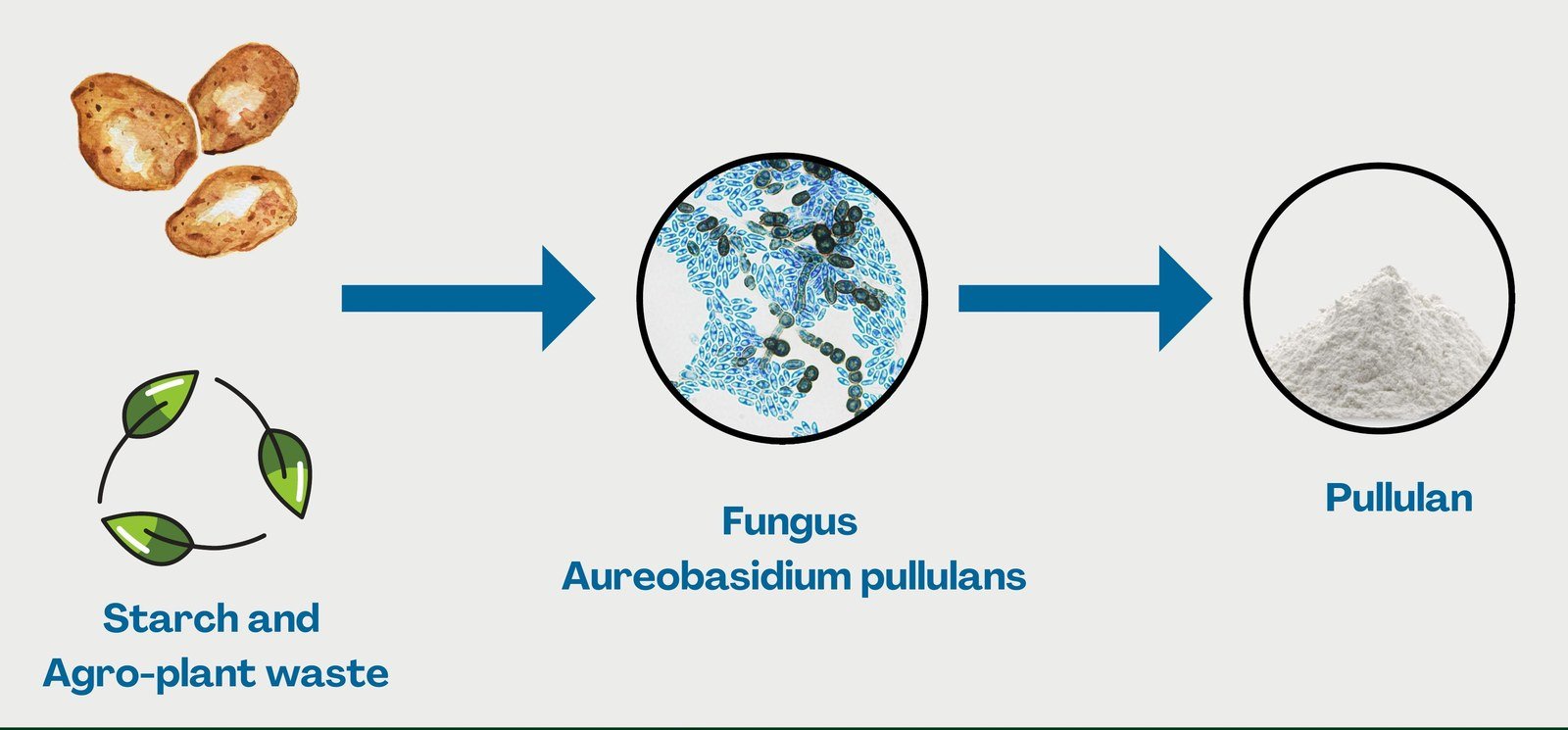
Starch and agricultural plant waste are fermented by the fungus Aureobasidium pullulans to produce pullulan powder
Starch and agricultural plant waste are fed to the fungus Aureobasidium pullulans, which releases pullulan as it grows. The result is a clear, tasteless powder that can be cast into film.

The chemistry

Pullulan is a chain of glucose units. Every three form a maltotriose block joined by alpha 1,4 bonds, and those blocks link to each other by alpha 1,6 bonds. That alternating pattern is the whole trick. The regular 1,4 runs give the film its strength, and the 1,6 links between them keep the chain flexible and highly soluble, which is how it holds a shape in hot water and then disappears.

Glca1,4Glca1,4Glca1,6Glca1,4Glca1,4Glca1,6n

Empirical formula
(C6H10O5)n
Repeating unit
Maltotriose, C18H32O16
CAS number
9057-02-7
Additive code
INS 1204
Produced by
Aureobasidium pullulans
Decomposes above
480 °F

Dissolves completely

Not softens, not fragments. It goes into solution in hot water and leaves nothing behind.

Made from waste, not oil

Starch and agricultural plant waste are the inputs. There is no petroleum anywhere in the pod.

Tasteless and odourless

It does not change how the coffee tastes, which is why it beat the other candidate materials.

Safe in food

Already used in breath strips and pill capsules. The FDA reviewed it for food use and responded with no questions.

A dietary fibre

Pullulan is a prebiotic fibre. Swallowed, it is treated as fibre rather than as a foreign material.

Blocks oxygen

Low oxygen permeability keeps the roast fresh on the shelf without an aluminium lid.
The problem to solve

What a pod has to survive

A pod has to do two opposite things. It must survive water at roughly 200 degrees Fahrenheit under pressure for the length of a brew, then dissolve or biodegrade once it is thrown away. Most materials can do one or the other.

StageWhat the pod is subjected toWhat the material has to do
ShelfMonths of oxygen exposure at room temperatureKeep oxygen out so the roast does not stale
PunctureNeedles pierce the lid and baseHold together rather than shatter or tear
ExtractionWater near 200 °F, forced through under pressure, for 20 to 30 secondsKeep its geometry so the water passes through the grounds, not around them
DisposalSoil or a home compost heap, no industrial processingDissolve or biodegrade in days, leaving no fragments

Strength against solubility

Solubility and strength usually move in opposite directions. A polymer chain that water can get into quickly is a chain that comes apart under stress. A chain packed tightly enough to resist hot water and pressure is one that soil bacteria struggle to digest.

Pullulan sidesteps that because of how it is built. Runs of three glucose units joined by alpha 1,4 bonds give the film order and tensile strength. The alpha 1,6 bond between each block interrupts that order, keeping the chain flexible and leaving room for water to penetrate. Strength from one bond type, solubility from the other, in the same molecule.

Glca1,4Glca1,4Glca1,6Glca1,4Glca1,4Glca1,6n

Figure 3Every candidate plotted on all five axes. Most spike on one or two and collapse elsewhere. Pullulan is the widest balanced shape.
Brew temperature
~200 °F
Thermal decomposition
above ~480 °F
Empirical formula
(C6H10O5)n
Repeating unit
Maltotriose, C18H32O16
CAS number
9057-02-7
Additive code
INS 1204
Definitions

How high, moderate and low were defined

Before any material was scored, each performance band was tied to a measurable threshold drawn from our own experiments and from published benchmarks, so a rating means the same thing in every row.

CriterionHighModerateLow
Biodegradability85% or more mass loss after 30 days in soil50 to 84% mass lossUnder 50% mass loss
SolubilityComplete dissolution within 60 seconds at about 200 °FDissolution within 1 to 5 minutesPartial or no dissolution after 5 minutes
Thermal stabilityNo visible deformation under water at about 200 °FMinor softening or deformation without structural failureSignificant deformation or structural collapse
FormabilityEasily moulded into capsule shape with strong structural retentionMouldable with some deformation or fragilityPoor shape formation, or unable to retain structure
Food contact safetyFDA approved for direct food contact (GRAS)Limited or indirect regulatory approvalNot approved for food contact
ScalabilityEstablished large scale production and commercial feasibilityEmerging production with scalability challengesLimited production, or experimental stage material

Table 1 from the paper: operational definitions and classification thresholds for biopolymer performance evaluation.

Screening

The scoring matrix

Nine candidates against six requirements. A material had to clear all six to stay in. Reading across a row shows why each one dropped out, and reading down a column shows how few materials clear any single requirement.

Meets the requirement Partial, workable but compromised Fails, disqualifying
Candidate Biodegrades
without industrial processing
Dissolves
completely in water
Forms a shell
castable and mouldable
Thermally stable
at 200 °F under pressure
Food safe
and allergen free
Scalable
at pod volumes
Pullulan
Polyvinyl alcohol
Sodium alginate
Polylactic acid
Cellulose
Hydroxypropyl methylcellulose
Gelatin
Seaweed extract
Chitosan
Figure 1The biodegradation column of the matrix, measured. Remaining mass from a 2 gram start across 90 days in soil. Pullulan and starch fall fastest; cellulose and chitosan barely move.

Pullulan is the only row without a disqualifying mark. Its one compromise is supply: it is produced commercially today, but by relatively few manufacturers, which is a cost and concentration risk rather than a technical one.

Method

How each property was measured

Every candidate was prepared the same way so the comparison held. Films were cast to a controlled thickness, cured, then put through the same sequence of tests.

  1. 01
    Film preparation

    Each biopolymer was dissolved to a working solution, cast onto a flat mould and dried to a target wall thickness. Thickness was the controlled variable, stepped from 0.2 mm to 1.0 mm, because it governs both structural strength and dissolution time and is the parameter a manufacturer would actually tune.

  2. 02
    Biodegradation

    Samples of equal starting mass, 2 grams, were placed in soil and recovered at intervals across 90 days. Remaining dry mass was recorded at each interval, which produces the decay curves in Figure 1. Reporting mass rather than visual breakdown matters, because a film can fragment while losing very little mass.

  3. 03
    Dissolution

    Films at each thickness were immersed and timed to complete dissolution, giving the curves below. The useful result is not a single number but the slope: how sharply dissolution time rises as the wall gets thicker determines whether a wall strong enough to brew through is still a wall that disappears.

    Figure 2Cellulose and PLA climb steeply as the wall thickens. Pullulan stays flat across the whole 0.2 to 1.0 mm range, which is what makes a brewable wall thickness possible.
  4. 04
    Thermal and pressure behaviour

    Shells were exposed to water at brewing temperature, around 200 °F, under pressure for the length of a full extraction. The pass condition was geometric: the shell had to keep its shape so water passes through the grounds rather than around a collapsed wall.

  5. 05
    Composite scoring

    Results across all six criteria were normalised and plotted together, producing the radar comparison in Figure 3. This is the step that separates a material that is excellent at one thing from a material that is adequate at everything, which is what a pod actually needs.

Results

The nine candidates

Eight of them failed on at least one criterion. Here is where each one fell down.

MaterialWhat it did wellWhy it was not used
PullulanDissolved completely, held its shape hot, food safe, broke down at homeSelected
Polyvinyl alcoholDissolved readily and broke down wellA synthetic polymer. We did not want manufactured plastic in a product sold as plastic free
Sodium alginateDissolved well, seaweed derivedThe film was too weak to hold shape under brewing pressure
Polylactic acidStrongest structural performance of the groupOnly composts in an industrial facility, which is the problem we set out to solve
CelluloseStrong and widely availableDoes not dissolve in water, so it leaves a capsule behind
Hydroxypropyl methylcelluloseGood film former, used in capsulesToo little margin between brewing temperature and the point where the film softens
GelatinForms films easily and is well understoodAnimal derived, which rules it out for a large share of coffee drinkers
Seaweed extractNatural and biodegradableAllergy risk, and inconsistent behaviour at brewing temperature
ChitosanNatural, antimicrobialDerived from shellfish, so it carries a serious allergy risk
Results

Prototyping

The measurements told us which material to use. Getting from that material to a shell that actually brews took another eighteen months.

Two hundred prototypes

The pattern that kept repeating was a trade off. Materials that dissolved quickly collapsed under pressure. Materials that held up under pressure would not biodegrade outside an industrial composter. Getting past that meant changing one variable at a time: film thickness, casting method, drying time, mould geometry.

We cast, moulded, brewed and destroyed more than two hundred shells over eighteen months on kitchen counters in New Jersey and Texas. In January 2025 a pullulan formulation held its shape through a full brew cycle and then dissolved on demand.

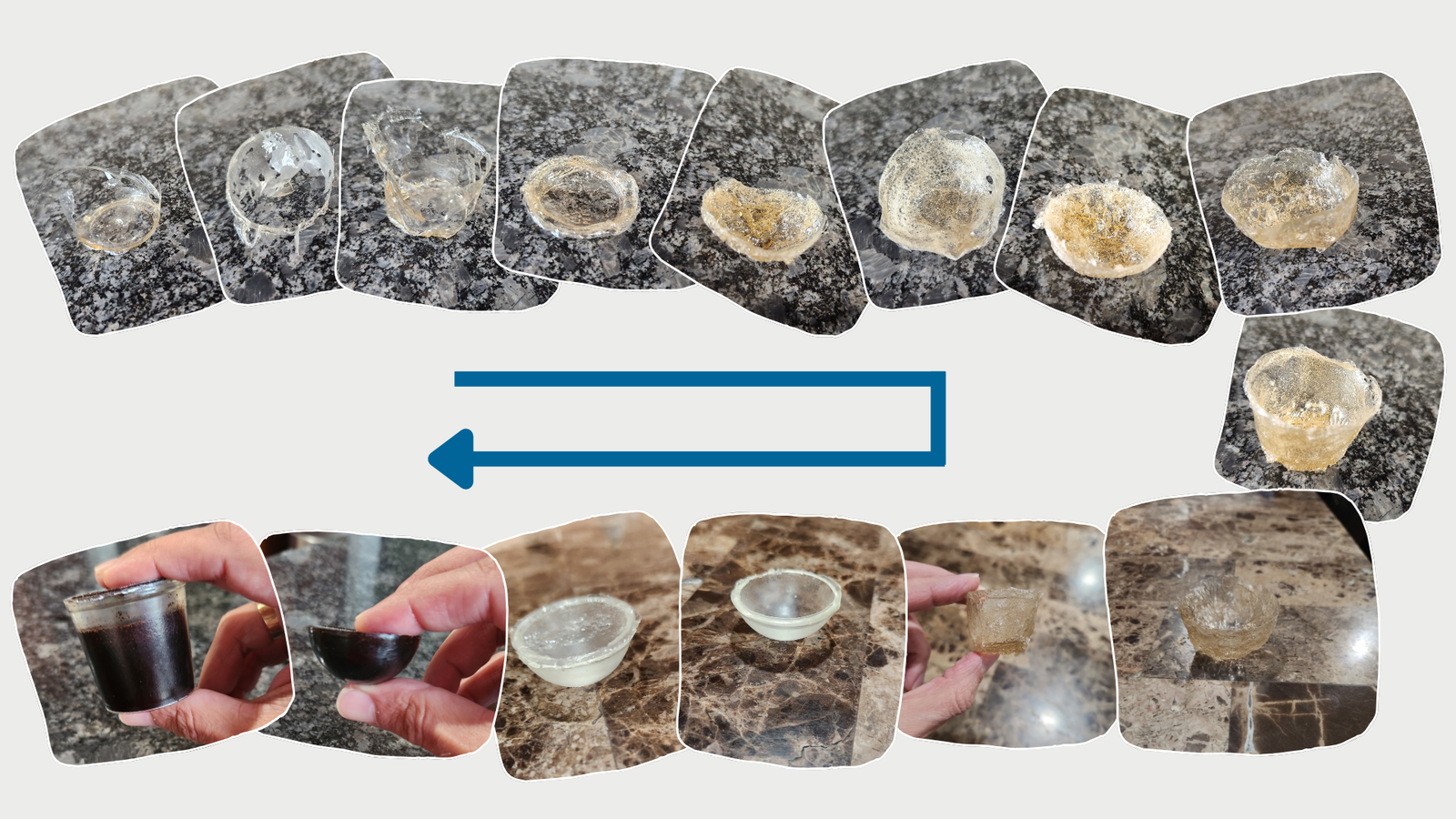
Fifteen cast pullulan shells arranged in order, from thin clear films through brittle cups to a finished pod holding brewed coffee
The prototype journey, in the order the shells were made. Read along the top row, then back along the bottom to the pod that brewed.
Beyond the kitchen

University research

Some problems, poor shelf life above all, could not be solved on a kitchen counter, so both founders took them into university laboratories. Karan did materials science research at UT Austin and Aditya researched shelf life extension at the Rutgers food science lab. What they learned came back to Naturista and made the pods better.

On video

Watch the work

Our research methodology How the nine candidates were cast, brewed and scored. Watch on YouTube ↗
Made in a home kitchen Blenders, baking trays and a domestic oven. How the first biopolymer pods were actually cast. Watch on YouTube ↗
Testing the instant pod An instant pod prototype dropped into hot water in the home lab. Watch on YouTube ↗
Testing the machine brew pod A machine pod prototype run through a full brew cycle in the home lab. Watch on YouTube ↗
Bibliography

References from the paper

Every work cited in Comparative Analysis of Biopolymer Candidates for Sustainable Coffee Pod Manufacturing, in the order they appear in the published reference list.

  1. 1
    Bracciale, M. P., De Gioannis, G., Falzarano, M., Muntoni, A., Polettini, A., Pomi, R., Rossi, A., Sarasini, F., Tirillò, J., & Zonfa, T. (2023). Anaerobic biodegradation of disposable PLA-based products: Assessing the correlation with physical, chemical and microstructural properties. Journal of Hazardous Materials, 452, Article 131244. doi.org
  2. 2
    Chiellini, E., Corti, A., D’Antone, S., & Solaro, R. (2003). Biodegradation of poly(vinyl alcohol)-based materials. Progress in Polymer Science, 28(6), 963–1014. doi.org
  3. 3
    Dewan, M. F., & Islam, M. N. (2024). Pullulan-based films: Unveiling its multifaceted versatility for sustainability. Advances in Polymer Technology, Article 2633384. doi.org
  4. 4
    Earth.Org. (2022, December 26). Coffee capsules: Brewing up an (in)convenient storm of waste. Earth.Org. earth.org
  5. 5
    Farris, S., Unalan, I. U., Introzzi, L., Fuentes-Alventosa, J. M., & Cozzolino, C. A. (2014). Pullulan-based films and coatings for food packaging: Present applications, emerging opportunities, and future challenges. Journal of Applied Polymer Science, 131(13), 40539. doi.org
  6. 6
    Zhao, M., Yang, Z., Zhao, J., Wang, Y., Ma, X., & Guo, J. (2022). Life cycle assessment of biodegradable polylactic acid (PLA) plastic packaging products—Taking Tianjin, China as a case study. Journal of Resources and Ecology, 13(3), 428–441. jorae.cn
  7. 7
    Mordor Intelligence. (2024). Coffee pods and capsules market: Growth, trends, and forecasts. mordorintelligence.com
  8. 8
    National Institutes of Health. (2020). A Detailed Review Study on Potential Effects of Microplastics and Additives of Concern on Human Health. pmc.ncbi.nlm.nih.gov
  9. 9
    Recycling Partnership. (2024). Only 21% of U.S. residential recyclables are captured: National recycling report. recyclingpartnership.org
  10. 10
    Smith, M., Love, D. C., Rochman, C. M., & Neff, R. A. (2018). Microplastics in seafood and the implications for human health. Current Environmental Health Reports, 5(3), 375–386. doi.org
  11. 11
    Wise Guy Reports. (2026). Global compostable coffee capsule market: Trends & growth analysis 2035. WiseGuy Reports. wiseguyreports.com
  12. 12
    Sun, X., Zhang, H., Wang, J., & Dong, M. (2021). Sodium alginate-based nanocomposite films with strong antioxidant and antibacterial properties enhanced by polyphenol-rich kiwi peel extracts bio-reduced silver nanoparticles. Food Packaging and Shelf Life, 29, 100741. doi.org
Sources

Sources

The claims on this site come from these. Where a figure is an industry estimate rather than a study, we say so.

Pullulan is safe in food
The US Food and Drug Administration reviewed pullulan for general food use and responded with no questions. The notice records that it dissolves readily in cold or hot water, forms films easily, blocks oxygen well, and only breaks down thermally above roughly 480 degrees Fahrenheit, far above brewing temperature.
FDA GRAS Notice GRN 000099, closed August 2002
How pullulan is made
The international food additive specification defines pullulan as the product of fermenting hydrolysed starch with a non modified, non pathogenic strain of Aureobasidium pullulans, then filtering, treating and drying it into a powder.
Joint FAO and WHO Expert Committee on Food Additives, 65th meeting, 2005
Microplastics in hot drinks
Microplastics were found in all 155 retail beverage samples tested. Hot coffee averaged 43 particles per litre and hot tea 60, against 17 for soft drinks. Hot drinks carried significantly more than cold, which points at temperature pulling polymer out of the packaging. Polypropylene, the plastic most coffee capsules are made from, was the most common polymer found.
Al-Mansoori, Harrad and Abdallah, Science of the Total Environment, 2025
Compostable pods need an industrial facility
Compostable pods broke down completely in 46 days, but only inside an industrial composting operation with piles several metres high, turned every other day and left to mature for six months. A home compost heap cannot reproduce that.
Kooduvalli, Vaidya and Ozcan, Scientific Reports, 2020
And most waste systems will not take them
A study of eight capsule types across the Netherlands, one of the most developed waste systems in Europe, found that most of the Dutch organic waste industry does not accept compostable coffee capsules at all.
Thoden van Velzen and others, Wageningen Food and Biobased Research, report 2450, 2023
Our own study
Nine materials, six criteria, laboratory film testing combined with a literature review. Pullulan returned the most balanced result.
Herekar and Verma, Future Scholars Journal, 2026
Note on the pod production figure
The figure of more than 80 billion pods made per year is an industry estimate reported in journalism rather than a peer reviewed measurement. We use it because it is the most widely cited number available, and we label it as an estimate wherever it appears.
Mongabay, December 2022
Enlarged image